HTML is the universal format for web content, making Word‑to‑HTML or Word‑to‑MHTML conversion essential for C++ developers who need to display documents in browsers or email clients. Aspose.Words for C++ provides a powerful, high‑performance API that simplifies converting Microsoft Word files (DOC/DOCX) to HTML or MHTML with advanced options such as embedded fonts and round‑trip metadata.
In this guide we cover:
- C++ Microsoft Word Files Converter API – Installation
- Convert Word to HTML using C++
- Convert Word to HTML with Embedded Fonts using C++
- Convert Word to HTML with Round‑Trip Information in C++
- Convert Word to MHTML in C++
C++ Microsoft Word Files Converter API – Installation
First, install Aspose.Words for C++ to enable Word document processing. The library is available via the NuGet gallery. Run the following command in the Package Manager Console:
Install-Package Aspose.Words.Cpp -Version 20.8.0
After installation, include the Aspose.Words headers in your C++ project to start converting DOC/DOCX files.
Convert Word (DOCX/DOC) to HTML using C++
Converting Word to HTML lets you render document content directly in a web browser. The conversion process consists of two simple steps:
- Load the source Word file.
- Save the document as HTML.
The snippet below demonstrates a minimal C++ program that loads a DOCX file and saves it as an HTML page.
Convert Word to HTML with Embedded Fonts using C++
Documents often use custom fonts that may not be available on the target device, resulting in garbled text. Aspose.Words for C++ can embed these fonts directly into the HTML output using Base64 encoding. Set the ExportFontsAsBase64 property before saving.
Steps:
- Load the source DOCX file.
- Enable
ExportFontsAsBase64. - Save the HTML file.
The following code shows how to embed fonts in the generated HTML:
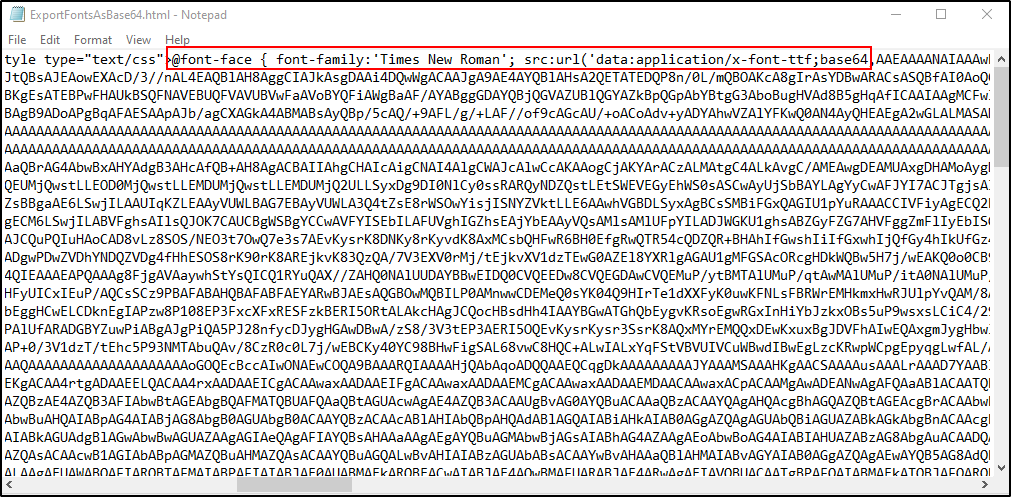
When you open the resulting HTML in a browser or view the source in a text editor, you will see the font data encoded as Base64 strings.
Convert Word to HTML with Round‑Trip Information in C++
HTML cannot represent every feature of a Word document. To preserve advanced Word features (such as comments, revisions, or custom XML) during a round‑trip conversion (Word → HTML → Word), enable ExportRoundtripInformation. This stores additional metadata in the HTML file, ensuring a lossless return to the original Word format.
Procedure:
- Load the source DOCX file.
- Set
ExportRoundtripInformationtotrue. - Save the document as HTML.
The example below illustrates how to activate round‑trip information:
Convert Word to MHTML in C++
MHTML bundles HTML, images, CSS, and other resources into a single file, simplifying distribution via email or offline viewing. Converting Word to MHTML with Aspose.Words follows the same two‑step pattern:
- Load the source DOCX file.
- Save the document in MHTML format.
The code snippet below performs the conversion:
Conclusion
This article demonstrated how to convert Word DOC/DOCX files to HTML or MHTML using C++. We covered basic conversion, embedding fonts as Base64, preserving round‑trip information, and generating single‑file MHTML output. For further assistance, visit our Free Support Forum.